Posts

Stress Test Results

US officials have made public the result of the stress test of banks . We provide here a summary of the main points: Scope Major Bank Holding Companies (BHC) - 19 in total. Those BHCs hold two thirds of assets and half of loans in the US banking system. Objective In an "adverse scenario", each BHC should have by 2010 a tier 1 capital ratio in excess of 6% and tier 1 common capital ratio in excess of 4%. Banks who don't satisfy both ratios will need to raise more capital to reach it. Results BHC have since the beginning of the financial crisis in 2007 lost $350 billion up to 31 Dec 2008. The stress test shows that further losses of $600 billion ($450 billion from loans and $135 billion from trading and securities) may occur within two years in the "adverse scenario", making the total losses reach $950 billion. In order to absorb such losses and keep the tier 1 ratios above the objective limit, BHCs will need to increase their tier 1 capital by $185 billion. More ...

Shadow banking system and macro-economic regulation

The World, and the US in particular, are facing a serious risk of deflation as individuals and corporations reduce their excessive debt/leverage all at the same time. Ben Bernanke, the Chairman of the Federal Reserve, explains why in this case, the central banks have to work with the treasuries to fight this risk. We also look at why the successive rate hikes have failed to curb the bubbling demand for credit: the answer is called shadow banking system. Ben Bernanke, May 2003, about the different roles of a central bank in inflationary and deflationary times, taking the example of Japan: "The Bank of Japan became fully independent only in 1998, and it has guarded its independence carefully, as is appropriate. Economically, however, it is important to recognize that the role of an independent central bank is different in inflationary and deflationary environments. In the face of inflation, which is often associated with excessive monetization of government debt, the virtue of an in...

New framework for European financial supervision

Image
Financial regulation in Europe has failed to stop the contagion of financial stress from the United States to Europe. While there is now a European Central Bank that sets the monitory policy for the Euro area, no single institution is responsible for overseeing European Banks and other financial institutions. Larosiere released on 25th February 2009 a report commissioned by the EU about how to reach such an objective. Here is the link to the report available for free The proposed new structure would be: While I welcome the move towards a better European integration, I find it not bold enough because it leaves the responsibilities spread across several institutions. Why not build a single entity, that would be alongside the ECB and that would have ultimate responsibility for financial supervision?

RBS: a wounded giant

Image
A few figures about RBS, which is on the brinks of collapse (it would already have without government's support): - Assets : £1.9 trillion - Liabilities: £1.8 trillion This makes it the World largest company by assets. By comparison, its assets represent more than the GDP of France! Nationalizing it, which appears likely to be the only solution considering further asset depreciation and continuing recession, would more than double the public debt of the United Kingdom. Ouch! At the time when they were buying ABN Amro, I was wondering how they could afford it while I was witnessing other banks downsizing. Well I have the answer now: they simply could not...

(BN) Deutsche Bank Trading Woes Persist as Weinstein-Led Unit Loses $1 Billion

More losses on proprietary trading in investment banks. With so much volatility in thé markets, one wonders how the proprietary desks can make regular and sustainable profits. Definitely not an easy time to be a prop trader! Bloomberg News, sent from my iPhone. Deutsche Bank Woes Said to Persist on Credit Bets Dec. 12 (Bloomberg) -- Deutsche Bank AG, shaken last quarter by a $1.68 billion loss trading for the firm's account, is reeling again, this time from about $1 billion of bad bets in a unit led by credit-trader Boaz Weinstein in New York, people familiar with the matter said. The magnitude of the group's loss, and its impact on the firm's fourth-quarter results, may change as the value of some stakes fluctuate with the markets and the Frankfurt-based bank seeks to unwind positions, according to the people, who declined to be identified because the circumstances haven't been disclosed. As of mid-Dece...

Don't believe analysts

Image
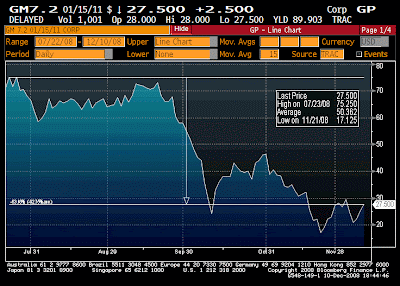
At least some of them! Here is a nice example: on July 22,2008, JP Morgan auto analyst advised to buy General Motors Bonds. (See the Reuters article ) At this time, the 7.2 bond expiring in 2011 was trading at $72, a bargain according to this analyst. Well, less than 5 months later, it's now trading at $27.5, 63% lower!! Source:Bloomberg What was the analyst thinking? GM has not been profitable since 2000, that's eight years! Source:Fortune In 2006, Carol Loomis, Fortune columnist, was already explaining why GM was heading for a wreck . What has changed since then?

Your personal bailout

Excellent video from Wallstrip. How much would you ask for your own bailout?