Posts

Negative rates, financial stability and old-style bank robbers
Image
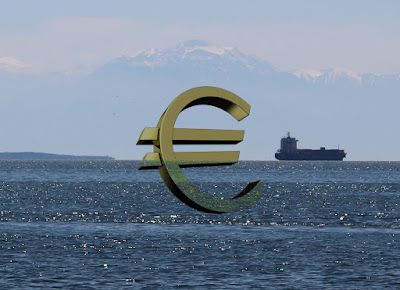
One of the main means for a central bank to promote financial stability is to set the interest rate at which it lends to banks. The lower the rate, the bigger the incentive for banks to do loans to finance companies and consumers' projects. The relationship is straightforward as long as the interest rate stays positive. Indeed, if the interest rate turns negative, negative side effects start to come up, and the point of this article is to highlight those side effects. A Euro dipping in the Aegean sea, in front of Mount Olympus (picture from the author) 1. Which rates does a central bank set? A typical central bank actually sets 3 different rates: - Deposit facility rate (or fed funds rate in the USA) = defines the interest banks receive for depositing money with the central bank overnight. It is compulsory for banks to depose part of their capital at the central bank and this amount is called reserve. - Main refinancing rate (or discount rate in the USA) = defines th...

European economy

Image
How well is Europe's economy doing? Following the European sovereign debt crisis and the Brexit (British exit from the European Union), are we about to witness a deepening European crisis fueled by structural issues? Or is it the case, as I heard several European institutional investors say, that European equities are the most promising assets to invest in because Europe is on the track to recovery and its market is undervalued compared to other regions in the World? For example, Igor de Mack, fund manager and spokesperson at DNCA Investments, said in a recent comment that "low valuations [of European equities] are increasingly compelling" Youngster carrying the European flag at the World Youth Days in Krakow, Polonia First let's look at the latest economic figures for the Eurozone. 1. A double-dip recession GDP growth shows the Eurozone suffered a double-dip recession, the first part being in 2008-2009, triggered by the global financial crisis, and the ...

Greek crisis: no job, no money, no problem

Image
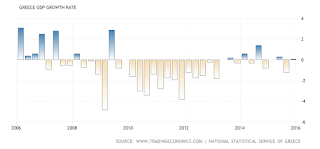
Seven years after the beginning of the Greek debt crisis, which started with newly elected Prime Minister George Papandreou discovering that Greek government budget numbers had been manipulated for years, is Greece out of the woods yet? Let's have a look at the latest economic data to see what has been the results of three bailout packages (2010, 2012 and 2015) and seemingly endless political drama. Did Greece choose the optimal path by opting to stay in the Eurozone or would it have been better off exiting the Eurozone in 2010? 1. The depression Between 2008 (when the global financial crisis propagated to Europe) and 2014, Greek GDP has collapsed by one third. This is huge, and even though it is not as bad as the Great Depression (between 1929 and 1933, US GDP dropped by 45%), it ranks as one of the worst depressions of any developed economy. In fact, ratings agency S&P has even downgraded in 2014 Greece from developed economy to emerging market status, which is the first...

Let's keep the Eurozone together. Really?

During the recent negotiations between Greece and its creditors about a debt restructuring programme, we learned that both parties were very keen on maintaining the Eurozone intact (aka Greece staying in the Eurozone). Why is it in their interests to do so? Let's see both sides arguments. First the Greek argument. The Greeks are going through incredibly harsh times with sky-high unemployment and plummeting income, so it's fair to wonder why they are so keen on staying in the Eurozone. What is so great about the Euro that a country is ready to face the threat of economic collapse to stay in it? Indeed what is happening in Greece now, with all banks being closed, capital controls and cash redrawal close to impossible, is a financial collapse similar to the one the U.S. had feared after Lehman Brothers  bankruptcy. With no lending, an economy cannot function properly, companies face liquidity crisis leading to being shut down, people don't invest or rather emigrate and the...

French industry's competitiveness

The Gallois report about the French industry's competitiveness has just been made public (links here ) and received a lot of publicity from the French media. As a trained economist and French patriot, I was eager to read it. The author, a respected businessman - formerly head of aerospace giant EADS -  describes rather briefly the declining state of the French industry over the last ten years, which accounted for 18% of GDP in 2000 and is now down to 12.5%. What are the causes of this decline? The author cites various causes, ranging from product quality, technology, labour flexibility, cost, competition, education and regulation. Standard economic theory says the government should increase labour flexibility, promote competition, support education and enact smart regulation. For example, the Porter Hypothesis (cf Ambec et al 2011 ) states that market-friendly environmental policy can enhance business competitiveness through innovation. What are the main propositions? Create...

Economics Nobel Prize 2012

Image
The Nobel Prize in Economics has been awarded to US economists Lloyd Shapley and Alvin Roth for their work on market design . Market design is a subfield of microeconomics that studies how to make markets work efficiently. By efficiently (also called Pareto efficiency), economists mean that the outcome (in terms of who gets what in the market) cannot be improved without making at least one person worse off. Most often this outcome can be achieved by letting people freely trade goods using money as a means of exchange. However, there are some cases where money cannot be used. For example, Alvin Roth studied the market for kidney transplants where buying kidneys is not allowed on ethical grounds. By creating a database of likely donors and patients along with an algorithm to match them, his work allowed to increase the number of transplants and therefore of lives saved. Below is a lecture from Alvin Roth where he explains this case and other applications of market design: At a time...

Ben Bernanke about Quantitative Easing

Yesterday, the US Federal Reserve Chairman Ben Bernanke gave an argumented speech in defense of Large Scale Asset Programs (also called Quantitative Easing in the Financial jargon) initiated in 2009 and that have been since then continued and expanded. Being a former academic researcher, Professor Bernanke was very careful in explaining his vision and his speech was both nice to read and very informative. What are the Large Scale Asset Programs? The role of LSAP is to continue easing financial conditions in the economy when the Central Bank's benchmark rates have reached the zero lower bound. This program is called unconventional because it lacks a standard model explaining why and how it should be used, and has been little used in history. It consists in letting the Central Bank purchase government assets (Treasury boons, or bonds issued by government sponsored agencies) so as to reduce the yield of such assets.  Quantitative evidence Econometric evidenc...