Posts

The day the US debt was downgraded
Image
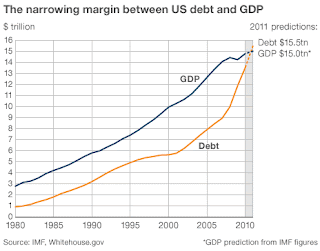
5th August 2011 is a historic day when ratings agency Standard and Poors downgraded the US public debt from AAA to AA+ for the first time in modern history. S&P downgrade explanation S&P took this decision to reflect the lack of leadership from US politicians to tackle urgently and decisively the mounting US public debt, which may exceed GDP soon as seen on the chart below. The debate frontier is now between the "spenders" like Paul Krugman - who think the US can recover from the crisis through more public spending which will lead to economic growth necessary to repay debt in the future - and the "deficit hawks" - who highlight that excessive debt raises the risk of a catastrophic default and therefore debt should be reduced urgently. The first view prevailed when a stimulus package was decided on the onset of the recession. The downgrade by S&P, which reflects the increasing riskiness of the US debt, goes in the direction of the second view by sh...

Tip: check your bank's credit rating

As we are in a period of significant credit risk (sovereign debt crisis, following a bank's crisis), it is necessary to check the credit worthiness of the institutions that you lend money to. So if you plan to put money in saving's account, don't only check the interest rate they offer you but also the bank's credit rating for the probability that you won't get your money back. This credit rating can be found in sites like  BankCreditRatings.co.uk  for the United Kingdom.

Impact of automatization on the organization of the High Tech industry

Image
Foxconn International Holdings, one of the largest manufacturer of mobile phones, whose clients include Nokia, Motorola and Apple, plans to automate a lot of its manufacturing processes by using increasingly more robots instead of humans as labour costs in China surge. Foxconn, a Taiwanese firm, is a typical example of the High Tech industry organization: Foxconn manufactures in China products designed in developed countries but now faces strong demand to increase salaries of Chinese workers. Looking at the broader picture, it is interesting to notice that rising salaries in China will have some macro impact on highly integrated industries like the High Tech industry. Historically, high tech jobs have been moved from developed countries to developing countries like China because of the savings related to using a cheap labour force. However, now that the gap in salaries is shrinking and humans are replaced with robots in manufacturing plants, there is no more competitive adva...

Macroeconomic fluctuations and asset prices

Here is a study I did with the help of Prof. Christian Hellwig from Toulouse School of Economics, about economic models of macroeconomic fluctuations and asset prices. I perform a review of the benchmark models with financial frictions and then propose a new model with additional frictions. I find that the benchmark models explain some of the output and price fluctuations by small aggregate shocks (to productivity, income or else). However, it is difficult to explain the magnitude of the asset price fluctuations observed in markets. The paper: https://docs.google.com/viewer?a=v&pid=explorer&chrome=true&srcid=0B1Wlp2QVrYS5MWFjMzk3YzYtNTJlMC00NDVkLTliNzgtNjFkYjkzZTQyOTVl&hl=en_US The presentation (attended by Profs. Franck Portier and Roberto Pancrazi): https://docs.google.com/viewer?a=v&pid=explorer&chrome=true&srcid=0B1Wlp2QVrYS5NGQxOTQxYjgtOGY2MC00MjMwLTg4ZGYtZTQzNTg3MjMwYTE0&hl=en_US Comments welcomed

Macro and growth policies in the wake of the crisis

A state-of-the-art conference on macroeconomics has been organized by Olivier Blanchard at the IMF. Although I could not attend it, I followed it on the website of the IMF. A lot of the most well-known economists attended: Joseph Stiglitz, Robert Solow, David Romer, George Akerlof, Maurice Obsfeld. As it was presented by academics, it's very research oriented, but definitely very informative even for the non-academics people. A summary of the results of this conference is given by Olivier Blanchard on VoxEU , a leading website for European economists. Here is the video:

What triggered the Arab revolutions of 2011?

Image
While watching on television (especially Al Jazeera, which had the best coverage) the "revolutions" enfold in Tunisa and Egypt, I have been wondering what triggered those dramatic but welcomed events. According to a lot of journalists, a significant cause was economic conditions: rising unemployment, low growth, high inflation. Hence, the person who started the Tunisian revolution was supposed to be someone who couldn't sell his production and put himself in fire in despair. So how exactly were Tunisian and Egypt economy faring? GDP growth (Source: IMF) Unemployment (Source: IMF) Inflation (source: IMF) Well, surprising as it may be, even after a worldwide recession, they were not faring too bad. Output growth was reasonably high (5.3% in Egypt and 3.8% in Tunisia) and rising in 2010. Unemployment has only increased by 1% since the 2007 and is still on a long-term declining trend. Inflation was only high in Egypt (above 10%) but not in Tunisia. So we ...

The Diamond, Mortensen and Pissarides Nobel: Search and market frictions

Barbara Petrongolo 15 October 2010 The 2010 Nobel Prize in Economics has been awarded to Peter Diamond, Dale Mortensen, and Christopher Pissarides "for their analysis of markets with search frictions". This column explains how their research relates to fundamental economic issues that are both at the core of the wellbeing of society at large and now near the top of many policymakers’ agendas. Various forms of imperfections or “frictions” characterise most real-world transactions. The coexistence of buyers and sellers in a given market, who can in principle agree on a price, may not be sufficient for immediate trade, as both buyers and sellers may need to invest in a costly search process in order to locate matching partners, and eventually need to agree to enter a transaction rather than wait for better trading opportunities. These frictions derive from several sources, including imperfect information about trading partners, heterogeneous demand and supply, slow m...