Posts

Macron, the budget and Europe

Image
The French 5-year budget plan currently under review in the French Parliament deserves careful attention because it is the first one under President Macron and a unique opportunity to address some of the structural weaknesses of the Eurozone’s second largest economy: a high level of taxes and public spending, a competitiveness problem and high unemployment. In NIESR’s November Review , we simulated the main measures of the plan and analysed their macroeconomic impact. We find that this plan strikes a fine balance between improving the French economy’s medium-term growth prospects, returning public finances to a more sustainable path and not damaging short-term GDP growth. However, the quantitative objectives set forth in the plan of reducing public deficit by 2 per cent of GDP and debt by 5 per cent of GDP by 2022 appear too optimistic, and this view is shared by the European Commission. Alexandre III bridge during a flood of the river Seine (June 2016 - picture taken by th...
Maintaining price stability with unconventional monetary policy measures

Very informative speech by Peter Praet, the European Central Bank's chief economist, in which he describes the decision making process in the ECB, and which tools it implemented after the beginning of the financial crisis. Reproduced with courtesy from the ECB's website . I was fortunate to be able to attend the MMF conference in London where the speech was delivered. The euro area continues to experience a solid, broad-based and resilient recovery. Deflationary risks have disappeared and some measures of underlying inflation have ticked up over recent months. But overall inflation developments, despite the solid growth, have remained subdued. Accordingly, while we remain confident that inflation developments will eventually return to levels below, but close to, 2% our medium-term objective, the evidence still shows insufficient progress towards a sustained adjustment in the path of inflation towards those levels. Such “sustained adjustment” is the principal contingency tha...

US long-run unemployment reaches lowest point in history

Image
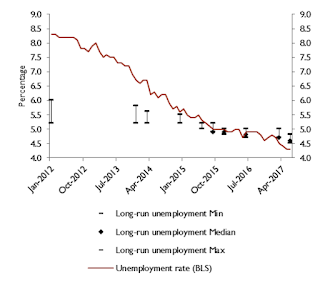
I first published this article on the National Institute of Economic and Social Research blog . It is reproduced here with permission. The natural rate of unemployment of the US economy has reached a lowest point since at least 1949. How can we explain such an achievement? And does it matter? In this blog post, I will explain what we mean by the natural rate of unemployment, give two explanations for its secular decline, and present one challenge ahead. 1. Different measures of the natural rate of unemployment point down At its June 13-14 meeting, the Federal Reserve Board’s Open Market Committee (FOMC) decreased its median estimate of the long-term unemployment rate from 4.7 to 4.6 per cent. This is the latest in a number of downward revisions of the FOMC’s estimate of normal unemployment over the past five years, which have amounted to about 1 percentage point in total (figure 1). According to the Fed’s publication, long-term unemployment rate is defined as the “unemployment ...

Three challenges for the French economy at the eve of a political transition

Image
I first published this article on the National Institute of Economic and Social Research blog . It is reproduced here with permission. As French citizens prepare to go to poll on Sunday to elect their representatives in the National Assembly, the lower – and more powerful - chamber of parliament, here is a snapshot of how the French economy has performed in the last five years, identifying three key challenges to long-term prosperity. To follow through on President Macron’s election on a reformist agenda, it is important that a majority willing to tackle those problems emerges from the assembly. Mont Saint-Michel, one of France's most touristic monuments. Picture by the author At the broadest level, the French economy under-performed its Euro Area partners for the last five years, extending earlier trends. French GDP per capita grew between 2011 and 2016 by 0.4% per annum compared to 0.5% in the Euro Area (figure 1), which means that French GDP per capita is now on...

Democracy, nationalism and hope

Image
Picture taken in Lanzarote, by the author I have received since the referendum in the United Kingdom about the European Union a lot of messages, tweets and talks of shock, denial or anger about the results of the UK referendum and of the US presidential elections. You, dear reader, probably witnessed the same thing so I don't need to quote them. Unfortunately, I saw much fewer messages of hope from people who triggered this change by voting for Brexit or for Donald Trump, or who are feeling supported by either cause. But this probably tells more about my network than the real diversity of people's opinion, even though I have always tried to have as open a network as possible. My argument in this post is that, whichever side of the argument you found yourself in, I will try and convince you that you should be optimistic about the future. Democracy is alive Firstly, the two political events mentioned previously were fantastic exercises of democracy. Brexit re...

Negative rates, financial stability and old-style bank robbers

Image
One of the main means for a central bank to promote financial stability is to set the interest rate at which it lends to banks. The lower the rate, the bigger the incentive for banks to do loans to finance companies and consumers' projects. The relationship is straightforward as long as the interest rate stays positive. Indeed, if the interest rate turns negative, negative side effects start to come up, and the point of this article is to highlight those side effects. A Euro dipping in the Aegean sea, in front of Mount Olympus (picture from the author) 1. Which rates does a central bank set? A typical central bank actually sets 3 different rates: - Deposit facility rate (or fed funds rate in the USA) = defines the interest banks receive for depositing money with the central bank overnight. It is compulsory for banks to depose part of their capital at the central bank and this amount is called reserve. - Main refinancing rate (or discount rate in the USA) = defines th...

European economy

Image
How well is Europe's economy doing? Following the European sovereign debt crisis and the Brexit (British exit from the European Union), are we about to witness a deepening European crisis fueled by structural issues? Or is it the case, as I heard several European institutional investors say, that European equities are the most promising assets to invest in because Europe is on the track to recovery and its market is undervalued compared to other regions in the World? For example, Igor de Mack, fund manager and spokesperson at DNCA Investments, said in a recent comment that "low valuations [of European equities] are increasingly compelling" Youngster carrying the European flag at the World Youth Days in Krakow, Polonia First let's look at the latest economic figures for the Eurozone. 1. A double-dip recession GDP growth shows the Eurozone suffered a double-dip recession, the first part being in 2008-2009, triggered by the global financial crisis, and the ...