Posts

How much would a ‘White Paper Brexit’ cost the UK economy?

Image
This blog article is the combination of a work that I did with my colleagues Amit Kara with some work that my other colleagues Rebecca Piggott and Arno Hantzsche did.It was first published in NIESR's blog and is reproduced here with permission. The UK government published a White Paper on 12th July outlining its preferences for a future relationship with the EU. In this blog we compare the proposals outlined in the White Paper against other EU free trade agreements (FTA) and also estimate the impact on the UK relative to our central forecast, published in August 2018, that assumes a soft Brexit. Our results suggest that the UK is looking for a trading relationship that is similar in scope to the arrangement between the EU and Switzerland. If that is indeed the case, we believe that the EU will insist that the UK make concessions on the freedom of movement of people and also ask for a budgetary contribution to EU programmes related to the single market. We estimate that the econo...

Forecasting recessions in the United States with the yield curve

Image
There is a large literature on the relationship between the yield curve and recessions that started in the 1980s as a result of the inability of macroeconomic models to explain sudden downturns in economic activity. In this box, we review the literature on the predictive power of the yield curve, with a particular focus on the United States, and compute the current implied probability of a recession using data ranging from 1953 to 2018. We find that a recession in the US is not likely soon, but the recent flattening of the yield curve should be monitored carefully. Recessions have often been associated with an inversion of the yield curve, moving from a positive slope to a negative one. A positive slope of the yield curve comes from the fact that investors require a premium for holding longer maturity bonds (the term premium) or expect the short-term rates to be higher in the future. A negative slope is a more unusual event – it has occurred less than 10 per cent of the time in the U...

The Great British Trade-Off

Image
I first published this article on the National Institute of Economic and Social Research blog . It is reproduced here with permission. For the non-British readers, the title is a play of words in reference to a famous BBC TV series, the Great British Bake Off. The British Prime Minister and four of her senior cabinet colleagues will in a series of speeches over the next few days set out a vision for the UK after Brexit. Those speeches will likely reiterate the government’s official goal of ‘free and frictionless’ trade with the EU. Less clear are the concessions that the UK is prepared to make to achieve this objective. In this blog we explore the likely trade-offs from the prism of a simple schematic and focus on three key areas of negotiation - market access, labour movement and budgetary contribution. There is no magic formula and the decision is ultimately political. With that in mind, the PM and her colleagues should spell the priorities on each of these three dimensions in th...

Macron, the budget and Europe

Image
The French 5-year budget plan currently under review in the French Parliament deserves careful attention because it is the first one under President Macron and a unique opportunity to address some of the structural weaknesses of the Eurozone’s second largest economy: a high level of taxes and public spending, a competitiveness problem and high unemployment. In NIESR’s November Review , we simulated the main measures of the plan and analysed their macroeconomic impact. We find that this plan strikes a fine balance between improving the French economy’s medium-term growth prospects, returning public finances to a more sustainable path and not damaging short-term GDP growth. However, the quantitative objectives set forth in the plan of reducing public deficit by 2 per cent of GDP and debt by 5 per cent of GDP by 2022 appear too optimistic, and this view is shared by the European Commission. Alexandre III bridge during a flood of the river Seine (June 2016 - picture taken by th...

Maintaining price stability with unconventional monetary policy measures

Very informative speech by Peter Praet, the European Central Bank's chief economist, in which he describes the decision making process in the ECB, and which tools it implemented after the beginning of the financial crisis. Reproduced with courtesy from the ECB's website . I was fortunate to be able to attend the MMF conference in London where the speech was delivered. The euro area continues to experience a solid, broad-based and resilient recovery. Deflationary risks have disappeared and some measures of underlying inflation have ticked up over recent months. But overall inflation developments, despite the solid growth, have remained subdued. Accordingly, while we remain confident that inflation developments will eventually return to levels below, but close to, 2% our medium-term objective, the evidence still shows insufficient progress towards a sustained adjustment in the path of inflation towards those levels. Such “sustained adjustment” is the principal contingency tha...

US long-run unemployment reaches lowest point in history

Image
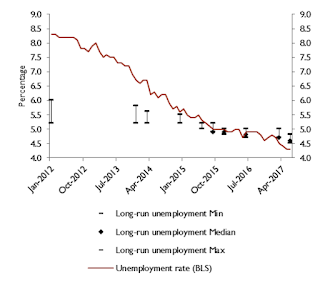
I first published this article on the National Institute of Economic and Social Research blog . It is reproduced here with permission. The natural rate of unemployment of the US economy has reached a lowest point since at least 1949. How can we explain such an achievement? And does it matter? In this blog post, I will explain what we mean by the natural rate of unemployment, give two explanations for its secular decline, and present one challenge ahead. 1. Different measures of the natural rate of unemployment point down At its June 13-14 meeting, the Federal Reserve Board’s Open Market Committee (FOMC) decreased its median estimate of the long-term unemployment rate from 4.7 to 4.6 per cent. This is the latest in a number of downward revisions of the FOMC’s estimate of normal unemployment over the past five years, which have amounted to about 1 percentage point in total (figure 1). According to the Fed’s publication, long-term unemployment rate is defined as the “unemployment ...

Three challenges for the French economy at the eve of a political transition

Image
I first published this article on the National Institute of Economic and Social Research blog . It is reproduced here with permission. As French citizens prepare to go to poll on Sunday to elect their representatives in the National Assembly, the lower – and more powerful - chamber of parliament, here is a snapshot of how the French economy has performed in the last five years, identifying three key challenges to long-term prosperity. To follow through on President Macron’s election on a reformist agenda, it is important that a majority willing to tackle those problems emerges from the assembly. Mont Saint-Michel, one of France's most touristic monuments. Picture by the author At the broadest level, the French economy under-performed its Euro Area partners for the last five years, extending earlier trends. French GDP per capita grew between 2011 and 2016 by 0.4% per annum compared to 0.5% in the Euro Area (figure 1), which means that French GDP per capita is now on...