Posts

Showing posts with the label Euro area and Greece

The macroeconomic and fiscal path in Greece during the economic adjustment programmes: 2010 to 2018

Image
In this conference organized by the Economic Chamber of Greece on 24 November 2020, we presented joint NIESR and CEPS work on debt sustainability analysis (presented by Cinzia Alcidi) and the macroeconomic and fiscal path (presented by Corrado Macchiarelli and myself) during the three adjustment programmes from 2010 to 2018 in Greece. The panel included Yiannis Stournaras, Governor of the Bank of Greece, Christos Staikouras, Minister of Finance of the Hellenic Republic and former Ministers of Finance Euclid Taskalotos and Evangelos Venizelos. The topics discussed included (in no particular order): Should the debt relief have come earlier? Should private sector involvement have been done earlier? Was the length and severity of the adjustment programmes appropriate? Was the mix of expenditure cuts and tax rises appropriate? Should public investment have been ring-fenced? Were the fiscal multipliers underestimated? Was the EU framework appropriate to manage such crisis? European Stability...

Are the Euro Area and the US en route to Japanisation?

Image
As part of NIESR's quarterly World Forecast, you will find a link to a box co-written by my colleagues Corrado Macchiarelli, Barry Naisbitt and myself about the risk of 'Japanisation' for the US and Euro Area economies. Here is an extract. Since the financial crisis, the Euro Area and US economies have had a period during which their economies showed some of the same characteristics as Japan. This note examines their experience in the context of whether they are en route to Japanisation. We conclude that the period from 2013 to 2016 was very similar to that situation but that the US has now clearly moved away from that experience. The Euro Area, however, while it cannot be described as having suffered Japanisation, has not moved as decisively away from that experience.

Macron, the budget and Europe

Image
The French 5-year budget plan currently under review in the French Parliament deserves careful attention because it is the first one under President Macron and a unique opportunity to address some of the structural weaknesses of the Eurozone’s second largest economy: a high level of taxes and public spending, a competitiveness problem and high unemployment. In NIESR’s November Review , we simulated the main measures of the plan and analysed their macroeconomic impact. We find that this plan strikes a fine balance between improving the French economy’s medium-term growth prospects, returning public finances to a more sustainable path and not damaging short-term GDP growth. However, the quantitative objectives set forth in the plan of reducing public deficit by 2 per cent of GDP and debt by 5 per cent of GDP by 2022 appear too optimistic, and this view is shared by the European Commission. Alexandre III bridge during a flood of the river Seine (June 2016 - picture taken by th...

European economy

Image
How well is Europe's economy doing? Following the European sovereign debt crisis and the Brexit (British exit from the European Union), are we about to witness a deepening European crisis fueled by structural issues? Or is it the case, as I heard several European institutional investors say, that European equities are the most promising assets to invest in because Europe is on the track to recovery and its market is undervalued compared to other regions in the World? For example, Igor de Mack, fund manager and spokesperson at DNCA Investments, said in a recent comment that "low valuations [of European equities] are increasingly compelling" Youngster carrying the European flag at the World Youth Days in Krakow, Polonia First let's look at the latest economic figures for the Eurozone. 1. A double-dip recession GDP growth shows the Eurozone suffered a double-dip recession, the first part being in 2008-2009, triggered by the global financial crisis, and the ...

Greek crisis: no job, no money, no problem

Image
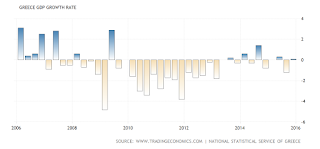
Seven years after the beginning of the Greek debt crisis, which started with newly elected Prime Minister George Papandreou discovering that Greek government budget numbers had been manipulated for years, is Greece out of the woods yet? Let's have a look at the latest economic data to see what has been the results of three bailout packages (2010, 2012 and 2015) and seemingly endless political drama. Did Greece choose the optimal path by opting to stay in the Eurozone or would it have been better off exiting the Eurozone in 2010? 1. The depression Between 2008 (when the global financial crisis propagated to Europe) and 2014, Greek GDP has collapsed by one third. This is huge, and even though it is not as bad as the Great Depression (between 1929 and 1933, US GDP dropped by 45%), it ranks as one of the worst depressions of any developed economy. In fact, ratings agency S&P has even downgraded in 2014 Greece from developed economy to emerging market status, which is the first...

Let's keep the Eurozone together. Really?

During the recent negotiations between Greece and its creditors about a debt restructuring programme, we learned that both parties were very keen on maintaining the Eurozone intact (aka Greece staying in the Eurozone). Why is it in their interests to do so? Let's see both sides arguments. First the Greek argument. The Greeks are going through incredibly harsh times with sky-high unemployment and plummeting income, so it's fair to wonder why they are so keen on staying in the Eurozone. What is so great about the Euro that a country is ready to face the threat of economic collapse to stay in it? Indeed what is happening in Greece now, with all banks being closed, capital controls and cash redrawal close to impossible, is a financial collapse similar to the one the U.S. had feared after Lehman Brothers  bankruptcy. With no lending, an economy cannot function properly, companies face liquidity crisis leading to being shut down, people don't invest or rather emigrate and the...

How the USA may end up killing the Euro

I have just completed reading the 2007 seminal article by Barry Eichengreen about "The Breakup of the Euro Area". The author describes the barriers that a nation would face should it decide to exit the Eurozone. The barriers are of different natures: legal, technical, political and economic. However, as we will see, the financial crisis, which originated in the USA with the subprime crisis before triggering a Euro crisis, has lowered these barriers significantly to a point where a break-up of the Eurozone has become a realistic scenario. The technical and legal barriers are about creating a new currency, redenominating debt in the new currency and enforcing it while preventing a probable bank run because citizens that expect a devaluation will try to send their money abroad. While undoubtedly large, those barriers are not insurmountable because it has already been done (example Argentina 2001) and this barrier may be effectively lowered when people, anticipating the poss...

The Euro Fiscal Rule

Image
Last night, the leaders of Europe agreed on a new  fiscal rule  to try and save their common currency. The official statement details the rule: "General government budgets shall be balanced or in surplus; this principle shall be deemed respected if, as a rule, the annual structural deficit does not exceed 0.5% of nominal GDP." We have computed the historical structural deficits to find out how tough the 0.5% benchmark is to achieve. As can be seen on the table below, among the fifteen major eurozone countries, only three countries (Belgium, Finland and the Netherlands) have managed to pass this rule succesfully (the green cells) in the last 9 years, and only one (Finland) has managed to pass it continously. Most countries have been far off the rule. Eurozone Governments' Structural Balance (computed from IMF data) Taking 30 years of data, we can see on the figure below that every single year, the vast majority of Eurozone countries have...

Is ECB biased towards inflation fighting?

Willem Buiter of the Financial Times seems to beleive so in the following article: Time for the ECB to get serious about the overvalued Euro Also an interesting question is should the ECB intervene on the FX market? What's sure is that no other Central Bank has any incentive to devalue the Euro.

New framework for European financial supervision

Image
Financial regulation in Europe has failed to stop the contagion of financial stress from the United States to Europe. While there is now a European Central Bank that sets the monitory policy for the Euro area, no single institution is responsible for overseeing European Banks and other financial institutions. Larosiere released on 25th February 2009 a report commissioned by the EU about how to reach such an objective. Here is the link to the report available for free The proposed new structure would be: While I welcome the move towards a better European integration, I find it not bold enough because it leaves the responsibilities spread across several institutions. Why not build a single entity, that would be alongside the ECB and that would have ultimate responsibility for financial supervision?

Plaidoyer contre la politique de la BCE

La Banque Centrale Européenne et à sa tête Jean-Claude Trichet, ont eu une gestion initialement contestable de la crise financière et leur politique risque de se revéler très négative à long terme. Lorsque la crise financière débuta en Aout 2007, ils ont mésestimé l'amplitude de la crise. J'en veux pour preuve qu'alors que la Fed a baisse ses taux très tôt, la BCE a pris la décision inverse en augmentant son principal taux directeur. Decision qui se révélera dans le future négative pour l'économie Europeenne. Pour rappel, l'Espagne était a l'époque déjà au bord de la récession et l'Italie a peine mieux. Seule l'Allemagne, généralement contra-cyclique résistait. Alors pourquoi avoir pris une telle décision? Officiellement, c'était pour combattre l'inflation provoquée par une hausse dramatique du cours des matières premières. Mais, il était pourtant prévisible que cette inflation allait ralentir en même temps que l'économie, d'autant plus q...

Will the Euro fall?

Image
Send to a Friend Print Article View as PDF Permissions/Reprints Thoughts from the Frontline Weekly Newsletter In this issue: The Problem with the Euro The Euro at Par with the Dollar The Euro at Par with the Dollar About five years ago, I said that the euro, which was trading at about $.88 at the time would rise to $1.50 and then fall back to $1 over the course of a decade or more. It would be one huge round trip. By the way, giving credit where credit is due, that opinion was crystallized over a long dinner with bond expert Lord Alex Bridport and several companions in Geneva. The logic was compelling then and it still is now. We are halfway through that decade long trip and it remains to be seen if we get back to parity. I think we will. Why would the euro fall? Because the currency is still an experiment in cooperation. At some point, one or more of the weaker European countries is going to need more monetary stimulation than the majority of the countries in the union, for a var...

Inflation in Eurozone reaches 3.2%

Image
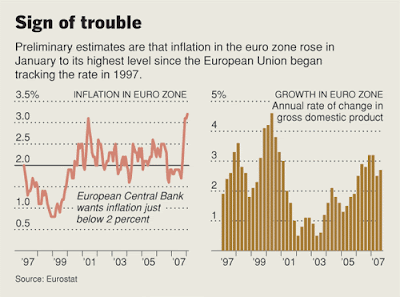
ECB will continue to keep interest rates high as opposed to other central banks (Fed and BOE) who slash them. European economy being not as flexible as US economy, an economic slow-down does not necessarily produce deflation, hence reducing the ability of the central bank to play with the interest rate instrument to help growth. Read-on IHT article

Ireland - The Celtic tiger can come roaring back

In this FT article, Ireland is presented as a country of -still- tremedous potential, thanks to its demographic dynamism. Full article http://www.ft.com/cms/s/0/a279b618-cdb4-11dc-9e4e-000077b07658.html The Celtic tiger can come roaring back By Marc Coleman Like a bicycle in a traffic jam, Ireland’s economy has defied every obstacle the world economy has thrown at it since the mid-1980s. In every year since 1993, gross domestic product grew by 4 per cent or more. But to many observers the lucky country now seems headed for a fall. With a quarter of its economy dependant on its property market, things look grim. But are they? In the short-term, the answer is yes. From just under 5 per cent last year, Ireland’s economy will grow by little more than 2 per cent next year. A three-year-old housing bubble is bursting, a process likely to take another nine months. More worrying is the fact that Ireland’s construction industry employs around 270,000 or 13 per cent of Ireland’s labour force. It...