Posts

Showing posts with the label Fiscal policy

Stop chasing the headroom: why Britain's fiscal plans should ignore forecast noise

Headroom, the few billion pounds by which the Chancellor is forecast to meet the fiscal rules, is the wrong target. It moves with forecast noise the Treasury barely controls, so chasing it makes tax and spending policy just as noisy. Set the rules once per parliament, stick to them unless there is a genuine crisis, and let voters judge the result at the end. On 28 October, the Chancellor will present his first Budget. The run-up has followed a familiar script. A new forecast arrives, the estimated "headroom" against the fiscal rules shrinks or grows by a few billion pounds, and taxes and spending are adjusted to match. For weeks, the debate about Britain's public finances comes down to a single number. That ritual is bad economics. Tax and spending decisions should aim for stability, for a tax system that makes the UK an attractive place to invest, and for long-term fiscal sustainability, not chase every change in the outlook. That requires fiscal rules set once, at the...

The macroeconomic and fiscal path in Greece during the economic adjustment programmes: 2010 to 2018

Image
In this conference organized by the Economic Chamber of Greece on 24 November 2020, we presented joint NIESR and CEPS work on debt sustainability analysis (presented by Cinzia Alcidi) and the macroeconomic and fiscal path (presented by Corrado Macchiarelli and myself) during the three adjustment programmes from 2010 to 2018 in Greece. The panel included Yiannis Stournaras, Governor of the Bank of Greece, Christos Staikouras, Minister of Finance of the Hellenic Republic and former Ministers of Finance Euclid Taskalotos and Evangelos Venizelos. The topics discussed included (in no particular order): Should the debt relief have come earlier? Should private sector involvement have been done earlier? Was the length and severity of the adjustment programmes appropriate? Was the mix of expenditure cuts and tax rises appropriate? Should public investment have been ring-fenced? Were the fiscal multipliers underestimated? Was the EU framework appropriate to manage such crisis? European Stability...

Macron, the budget and Europe

Image
The French 5-year budget plan currently under review in the French Parliament deserves careful attention because it is the first one under President Macron and a unique opportunity to address some of the structural weaknesses of the Eurozone’s second largest economy: a high level of taxes and public spending, a competitiveness problem and high unemployment. In NIESR’s November Review , we simulated the main measures of the plan and analysed their macroeconomic impact. We find that this plan strikes a fine balance between improving the French economy’s medium-term growth prospects, returning public finances to a more sustainable path and not damaging short-term GDP growth. However, the quantitative objectives set forth in the plan of reducing public deficit by 2 per cent of GDP and debt by 5 per cent of GDP by 2022 appear too optimistic, and this view is shared by the European Commission. Alexandre III bridge during a flood of the river Seine (June 2016 - picture taken by th...

The Euro Fiscal Rule

Image
Last night, the leaders of Europe agreed on a new  fiscal rule  to try and save their common currency. The official statement details the rule: "General government budgets shall be balanced or in surplus; this principle shall be deemed respected if, as a rule, the annual structural deficit does not exceed 0.5% of nominal GDP." We have computed the historical structural deficits to find out how tough the 0.5% benchmark is to achieve. As can be seen on the table below, among the fifteen major eurozone countries, only three countries (Belgium, Finland and the Netherlands) have managed to pass this rule succesfully (the green cells) in the last 9 years, and only one (Finland) has managed to pass it continously. Most countries have been far off the rule. Eurozone Governments' Structural Balance (computed from IMF data) Taking 30 years of data, we can see on the figure below that every single year, the vast majority of Eurozone countries have...

The day the US debt was downgraded

Image
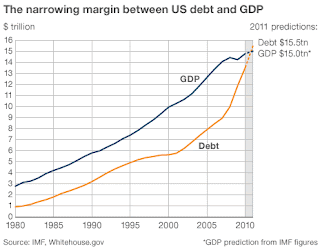
5th August 2011 is a historic day when ratings agency Standard and Poors downgraded the US public debt from AAA to AA+ for the first time in modern history. S&P downgrade explanation S&P took this decision to reflect the lack of leadership from US politicians to tackle urgently and decisively the mounting US public debt, which may exceed GDP soon as seen on the chart below. The debate frontier is now between the "spenders" like Paul Krugman - who think the US can recover from the crisis through more public spending which will lead to economic growth necessary to repay debt in the future - and the "deficit hawks" - who highlight that excessive debt raises the risk of a catastrophic default and therefore debt should be reduced urgently. The first view prevailed when a stimulus package was decided on the onset of the recession. The downgrade by S&P, which reflects the increasing riskiness of the US debt, goes in the direction of the second view by sh...

US debt/GDP ratio

Image
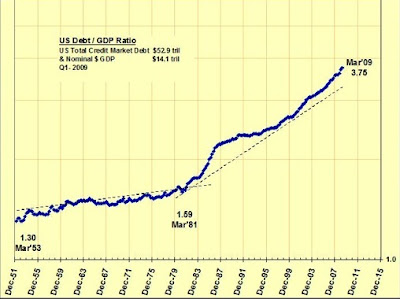
Excess leverage was at the root of the current economic crisis. This chart shows that debt is still increasing because of huge government spendings. We have a long way to go back to more sustainable levels... Source: John Mauldin's newsletter

Exploding debt threatens America - Top Stories - FT.com

http://m.ft.com/cms/s/0/71520770-4a2c-11de-8e7e-00144feabdc0.html?catid=2&SID=bf897f14bae9c5102c8ac3f2bf14958f Cyrille http://cyrilleuk.blogspot.com Sent from my iPhone

UK companies pay more taxes than their European counterparts

A recent study showed that UK companies paid much more taxes that French or German companies. Tax paid on value-added: - 6% Germany - 8% France and Germany - 12% United Kingdom